
How to Build an AI Chatbot for a Real Estate Website (2026 Step-by-Step Guide)
A practical guide to building a real estate AI chatbot that can answer questions, recommend listings, qualify buyers and sellers, capture lead details, and move visitors toward calls, bookings, and site visits.
Most real estate websites do not have a traffic problem.
They have a conversion gap.
People land on listing pages.
They compare options.
They check prices.
They wonder whether a property fits their budget, timeline, and location preference.
And then?
They leave.
No inquiry.
No callback request.
No site visit.
No lead.
That is the real problem.
Because in real estate, the biggest leak often happens between interest and action.
That is exactly where an AI chatbot can help.
Instead of asking a visitor to figure everything out alone, your website can start a useful conversation immediately.
It can answer common questions.
It can narrow choices.
It can qualify intent.
It can guide the next step.
And that changes the role of the website completely.
It stops being a static brochure.
It starts behaving more like a digital sales assistant.

In this guide, you will learn:
- what a real estate AI chatbot is and how it fits into the funnel
- how to choose the right use case before building anything
- the exact features, flows, prompts, and integrations that matter most
- how to connect chat with booking, follow-up, and CRM workflows
- how to make the page stronger for SEO, AEO, and conversion
Quick Answer: How to Build an AI Chatbot for a Real Estate Website
To build an AI chatbot for a real estate website, start with one clear use case such as buyer qualification, seller inquiries, property recommendations, or appointment booking.
Then connect the chatbot to accurate real estate data, design a structured lead qualification flow, add CRM and booking integrations, and place the chatbot on high-intent pages like listing pages, project pages, and contact pages.
The best real estate chatbot is not just a support widget. It is a lead capture, qualification, and conversion system.
Sounds simple.
But here is the catch.
Most chatbot guides focus on tools.
The real advantage comes from building the chatbot around the lead journey.
That is the difference between a chatbot people ignore and a chatbot that actually helps generate conversations, bookings, and qualified leads.
What Is an AI Chatbot for a Real Estate Website?
An AI chatbot for a real estate website is a conversational assistant that helps visitors ask questions, discover relevant properties, clarify what they want, and move toward an action such as requesting a callback, booking a site visit, downloading a brochure, or speaking with an agent.
Unlike a basic rules-based chat widget, an AI chatbot can handle more natural questions and guide visitors more flexibly.
What it should actually do
- answer common property and project questions
- recommend listings based on budget, location, and intent
- qualify buyers, renters, or sellers
- capture lead details without creating too much friction
- book appointments or site visits
- send hot leads into your CRM or sales workflow
- hand the conversation to a human when needed
Rules-based chatbot vs AI chatbot vs human follow-up
A basic chatbot follows a fixed path.
An AI chatbot can understand broader questions and adjust the conversation.
A human agent closes the loop when the lead is hot, complex, or ready to move.
That is the ideal model.
Not chatbot instead of people.
Chatbot plus people.
In other words: the chatbot handles the first layer of speed and structure, while the sales team handles trust, nuance, and closing.
Why Real Estate Websites Need AI Chatbots
Let’s be honest.
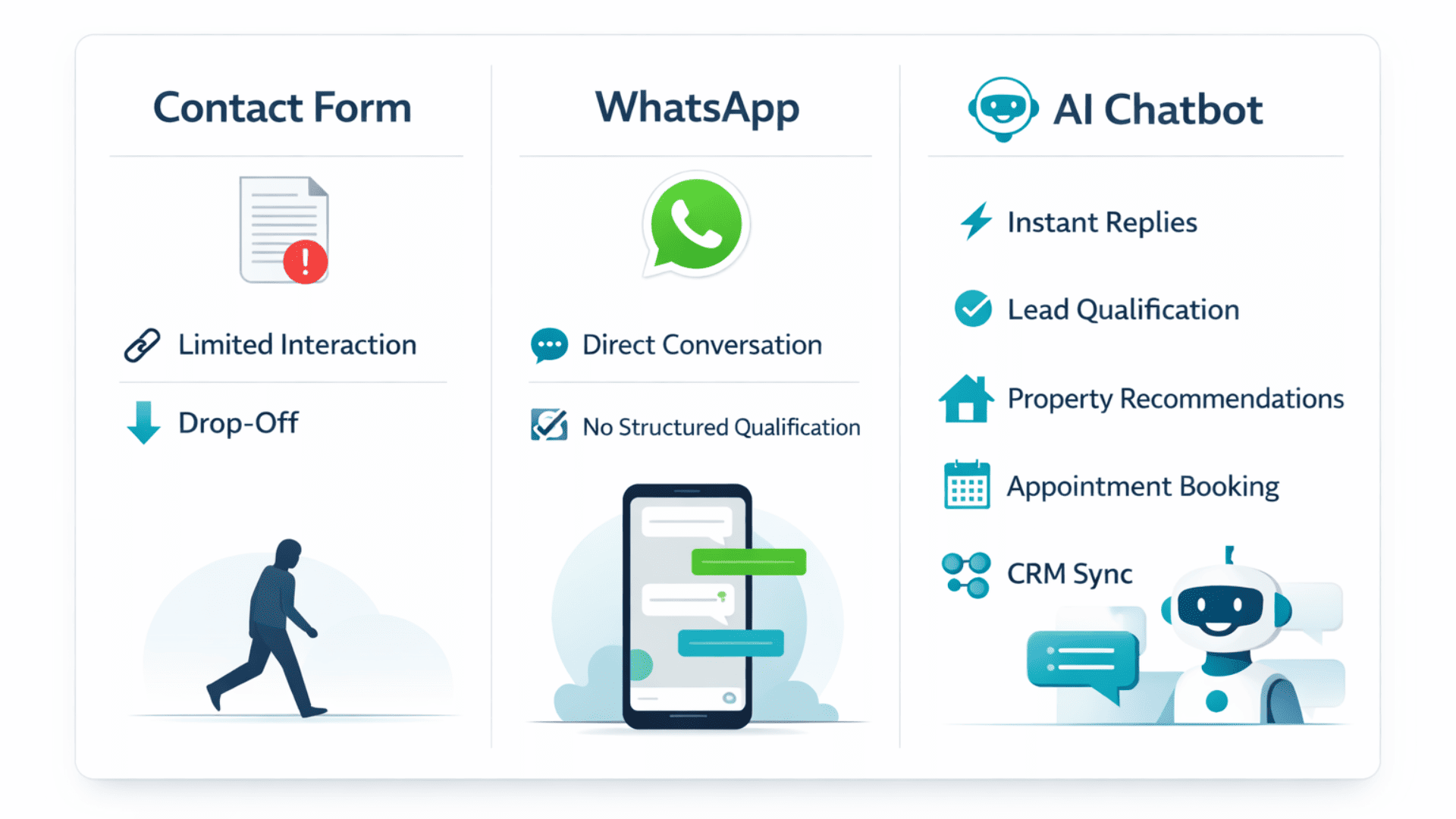
Contact forms are passive.
WhatsApp buttons are useful, but the flow is usually unstructured.
And traditional live chat often depends on someone being available at the exact moment a visitor has a question.
That leaves a gap.
An AI chatbot fills that gap by creating an instant, guided interaction.
| Option | What it does well | Main limitation |
|---|---|---|
| Contact Form | Simple lead capture | No conversation, no qualification, high drop-off risk |
| WhatsApp Button | Fast direct messaging | Weak structure unless someone handles every inquiry well |
| Live Chat | Helpful when staff is available | Coverage drops after hours or during busy periods |
| AI Chatbot | Conversation, qualification, routing, booking support | Needs the right setup, data, and workflow design |
Trust and Proof: Why This Matters in the Real World
Here is where things get interesting.
A chatbot is not valuable because it feels modern.
It is valuable because it helps solve real conversion problems.
And the underlying signals behind that are strong.
In a large lead-response study, firms that tried to contact potential customers within an hour were nearly seven times as likely to qualify the lead compared with firms that waited longer.
Among buyers who used the internet during their home search, photos were one of the most-used online resources, and detailed property information was also heavily used.
Modern chatbot platforms are routinely positioned for answering common questions, qualifying leads, and booking meetings, which is exactly why chat fits early-stage real estate conversion so well.
Put simply:
Real estate buyers already search online, compare details, and expect faster answers.
So when your site can respond, qualify, and route them quickly, the experience becomes stronger.
That does not close the deal by itself.
But it does improve the path toward the deal.
Why AI Chatbots Matter More in Real Estate Now
Real estate buyers and sellers expect faster answers than before.
They compare options quickly.
They browse multiple tabs.
They jump between portals, websites, WhatsApp, and social platforms.
That means the website needs to do more than display information.
It needs to help the visitor move.
This is also why chatbot strategy should not live in isolation.
It works best inside a broader acquisition and conversion system.
For example, once you start attracting qualified traffic through an AI-driven real estate lead generation strategy, a chatbot becomes much more valuable because it helps convert that intent while the visitor is still engaged.
That is where the compounding effect starts.
Before You Build: Define the Goal of Your Chatbot
This step matters more than most people think.
Because if the chatbot tries to do everything, it usually becomes generic and weak.
Start with one primary goal.
Capture more buyer, seller, or renter inquiries from website visitors.
Collect budget, location, property type, timeline, and financing intent.
Suggest relevant projects or listings based on the visitor’s inputs.
Guide qualified prospects toward callbacks, consultations, and site visits.
Best starting point?
For most real estate websites, buyer qualification or site-visit booking is the strongest first use case.
Why?
Because both sit close to revenue.
And that gives you a cleaner way to measure results.
Who Should Build a Real Estate Chatbot First?
This guide is especially useful if you are:
- a real estate agent who gets inquiries but struggles with follow-up consistency
- a brokerage that wants cleaner lead routing and better qualification
- a developer or project marketer who wants more brochure requests and site visits
- a portal or larger team that needs structured lead capture at scale
If you only want a basic live chat box, this is overkill.
But if you want a system that helps move visitors toward meaningful next steps, this is exactly the right approach.
Core Features Every Real Estate AI Chatbot Should Have
This is where a good chatbot starts to separate itself from a forgettable one.
It should understand normal questions, not just fixed button clicks.
It should guide users toward suitable options based on budget, location, and intent.
It should collect lead details naturally instead of pushing a cold form too early.
Budget, timeline, location preference, and property type should all shape the conversation.
It should move users toward calls, brochures, consultations, and site visits.
Hot leads should move into the sales workflow quickly and clearly.
Must-have vs nice-to-have features
Must-have at launch
- clear qualification flow
- useful answers to core questions
- lead capture
- CRM or notification routing
- a clear next-step CTA
- fallback to human support
Nice-to-have later
- multilingual support
- smart personalization
- recommendation scoring
- advanced segmentation
- deeper listing sync
- channel expansion into WhatsApp or SMS
That distinction matters.
Because a chatbot does not need to be complex on day one.
It needs to be useful.
How to Build an AI Chatbot for a Real Estate Website: Step by Step
Now let’s get practical.
Choose the use case
Start with one journey such as buyer qualification, seller inquiry, rental support, or booking.
Choose the setup
Decide between no-code, low-code, hybrid, or custom based on speed and flexibility.
Add the knowledge layer
Feed it listings, FAQs, amenities, pricing context, neighborhood details, and policies.
Design the conversion flow
Ask the right questions in the right order and connect them to real next steps.

Step 1: Choose the use case first
Good examples include:
- buyer lead qualification
- seller valuation requests
- rental inquiry routing
- project-specific chatbot support
- after-hours lead capture
- site-visit booking
Do not start with “we want an AI chatbot.”
Start with “we want to improve this part of the funnel.”
That gives the build a job.
Step 2: Decide between no-code, low-code, hybrid, and custom
No-code is best when speed matters most.
Low-code is better when you want more workflow flexibility.
Hybrid is great when you want to launch quickly without locking yourself into a weak long-term setup.
Custom is best when you need deeper control, branded logic, listing sync, and advanced routing.
Step 3: Build the knowledge base
Feed the chatbot with:
- property listings and configurations
- pricing ranges and payment plan context
- project highlights and amenities
- location and neighborhood information
- builder, developer, or brokerage details
- FAQs and common objections
- office hours, booking details, and next-step policies
And here is the key point:
Do not let the chatbot guess critical facts.
Pricing, availability, inventory status, possession timelines, and policy details should come from controlled inputs.
Step 4: Design the qualification flow
A strong chatbot should ask smart questions such as:
- are you buying, renting, or selling?
- which location are you considering?
- what is your budget range?
- what property type are you looking for?
- are you looking for ready-to-move or under-construction?
- what is your timeline?
- do you want recommendations, a callback, or a site visit?
Simple.
But powerful.
Because this is where casual interest starts turning into usable lead context.
Step 5: Add next-step actions
This is where the chatbot stops being a content box and starts becoming a workflow layer.
Useful actions include:
- book a call
- request a callback
- schedule a site visit
- send a brochure
- notify an agent
- route leads into CRM
- trigger follow-up sequences
- escalate high-intent visitors to a human
Step 6: Write the prompt logic and behavior rules
Define:
- brand tone
- response style
- when the chatbot should ask follow-up questions
- what it should never assume
- when to offer recommendations
- when to capture details
- when to escalate to a human
A simple direction can look like this:
Answer clearly and concisely. Ask one relevant follow-up question at a time. Never invent pricing or availability. If the user shows booking intent, move them toward a call, callback, brochure, or site visit.
Step 7: Place it on the right pages
But the short version is this:
Do not hide the chatbot only on the homepage.
That is one of the easiest ways to weaken performance.
Step 8: Test real conversations before launch
Check for:
- vague answers
- wrong answers
- dead ends
- weak qualification
- poor mobile experience
- too much friction before lead capture
- unclear handoff moments
Step 9: Track and improve
Track:
- chat start rate
- lead capture rate
- qualified lead rate
- booking rate
- escalation rate
- drop-off points
- unanswered questions
- top prompts that create poor responses
This is where the real gains appear.
Not on launch day.
But after you start improving real conversations.
What Data Should You Feed Into a Real Estate Chatbot?
Here is where many chatbot setups start to break down.
The model may be strong.
But if the information it has access to is weak, outdated, or generic, the conversation still feels unhelpful.
Your chatbot should ideally have access to:
- property details
- project information
- location-specific content
- amenities
- price ranges
- payment plan context
- FAQs
- objection-handling patterns
- booking and consultation details
The easiest way to weaken a chatbot
Give it vague marketing copy.
That is where things go wrong.
A visitor asks:
Do you have a 2BHK in this budget near this area?
And the chatbot responds with something polished but useless.
That kills trust fast.
Better input leads to better answers. Better answers lead to better lead quality.
Sample Real Estate Chatbot Conversation Flow
Let’s make this practical.
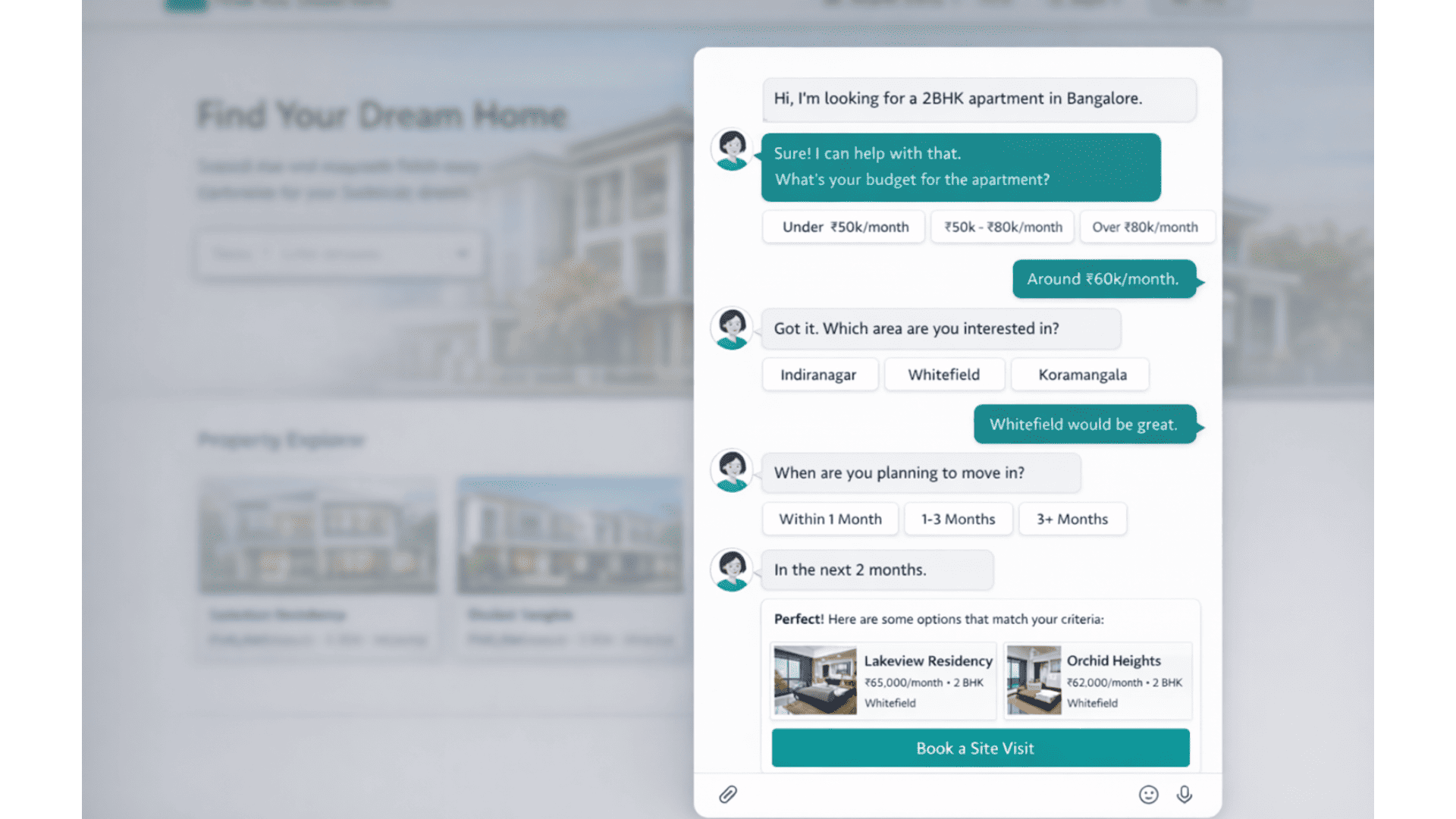
Buyer Flow Example
User: I am looking for a 2BHK in Surat.
Bot: Sure. Which area are you considering, and what budget range do you have in mind?
User: Near Vesu or Adajan, under 50 lakhs.
Bot: Got it. Are you looking for ready-to-move options or under-construction properties?
User: Ready to move.
Bot: I can help with that. Would you like relevant options first, or would you prefer to book a call or site visit with an advisor?
Seller flow example
A seller-focused chatbot may ask:
- which locality is the property in?
- what property type are you planning to sell?
- are you looking for a quick sale or market valuation first?
- would you like a valuation callback?
Renter flow example
A renter-focused chatbot may ask:
- preferred location
- monthly rent budget
- move-in timeline
- furnished vs unfurnished
- family or bachelor preference
- schedule a property viewing
Human handoff example
If a visitor asks something sensitive, complex, or high-intent, the chatbot should say:
I can connect you with an advisor for the next step. Would you like a callback, brochure, or site visit?
That is where the handoff should feel natural, not abrupt.
Best Tech Stack Options for a Real Estate Chatbot
Best for: solo agents and small teams
Strength: fast launch and easier setup
Limitation: less control over deeper logic and integrations
Best for: growing teams that want stronger automation
Strength: better workflow flexibility and routing control
Limitation: more setup complexity than no-code
Best for: portals, developers, and larger brokerages
Strength: full control, better branding, listing sync, and advanced logic
Limitation: requires more development and maintenance effort
Best for: teams that want speed now and stronger systems later
Strength: practical balance between launch speed and flexibility
Limitation: can become messy without a clear roadmap
Which option should most teams choose?
For many real estate businesses, hybrid is the best path.
Why?
Because it lets you launch faster without pretending that the first version has to be perfect.
You get speed now.
And room to improve later.
Why CRM and Booking Integration Matter
This is where chatbot value becomes real.
Because collecting messages is not enough.
The chatbot needs to connect to action.
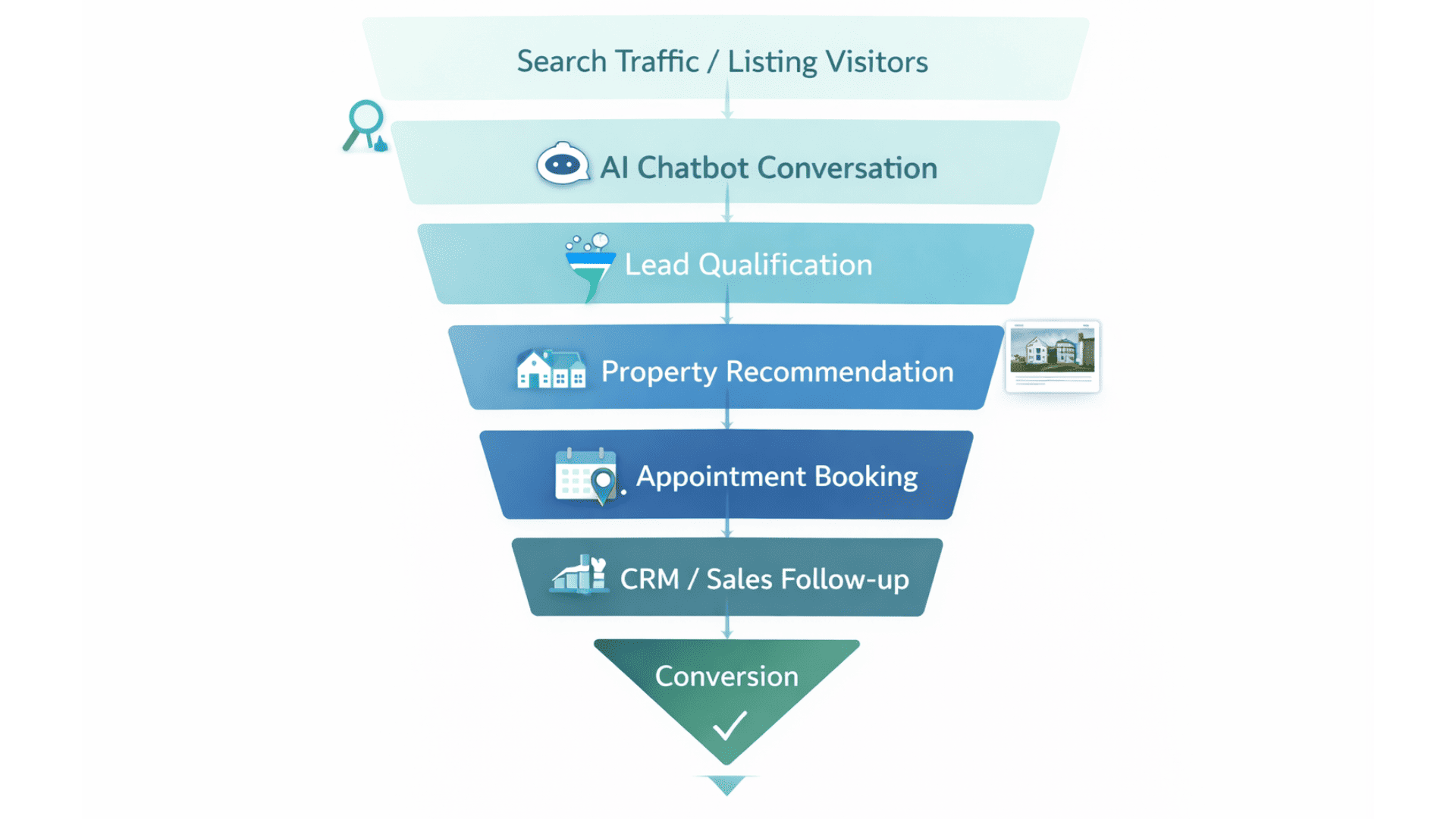
That means:
- pushing lead details into CRM
- routing inquiries by project, location, or intent
- sending notifications to agents
- logging qualification details
- triggering follow-up
- enabling direct booking for calls, consultations, or site visits
This also connects naturally with follow-up.
Because capturing a lead is only the first win.
Converting that lead depends on what happens next, which is why the strongest chatbot builds usually connect into a structured AI-powered real estate follow-up workflow instead of relying on manual reminders and inconsistent callbacks.
That is the difference between a lead captured and a lead progressed.
Best Pages to Add an AI Chatbot on a Real Estate Website
Placement matters more than many site owners expect.
A chatbot hidden only on the homepage will miss some of your most valuable traffic.
Here is a smarter placement model:
| Page Type | Visitor Intent | Best Chatbot Job |
|---|---|---|
| Homepage | Broad discovery | Route users by buying, renting, selling, or exploring |
| Listing Pages | High evaluation intent | Answer fit questions and capture lead details |
| Project Pages | Strong commercial interest | Offer brochure, call, or site visit |
| Seller Pages | Valuation intent | Capture property details and route seller leads |
| Contact Page | Action-ready | Book callback or consultation |
| High-Intent Blog Posts | Problem-solving intent | Bridge content readers into chat-assisted conversion |
And that last point matters.
Because when your content already attracts relevant readers, the chatbot becomes the bridge between information and inquiry.
That is also why teams comparing options often end up evaluating the broader stack of AI tools used for real estate lead generation rather than looking at the chatbot as an isolated feature.
The chatbot is one part of the system.
Not the whole system.
How This Article and Chatbot Strategy Support SEO and AEO
A chatbot does not replace SEO.
It improves what happens after SEO works.
That is the key.
Search brings the visitor.
The chatbot helps convert the visit.
This is especially useful on bottom-funnel pages where users arrive with questions like:
- which option fits my budget?
- should I book a site visit?
- what locality makes sense for me?
- what is the next step?
How to make the page stronger
- answer the main query early
- use clear subheadings
- add comparison elements
- include realistic examples
- use image captions that teach, not just describe
- cover related questions naturally
- add internal links where they deepen the point being made
- make the next step obvious
And if you use ChatGPT to help build prompts, qualification flows, and conversation drafts, this becomes much easier to operationalize inside a workflow similar to using ChatGPT for real estate leads, where content, qualification, and follow-up start supporting one another.
Where the Chatbot Fits in the Real Estate Funnel
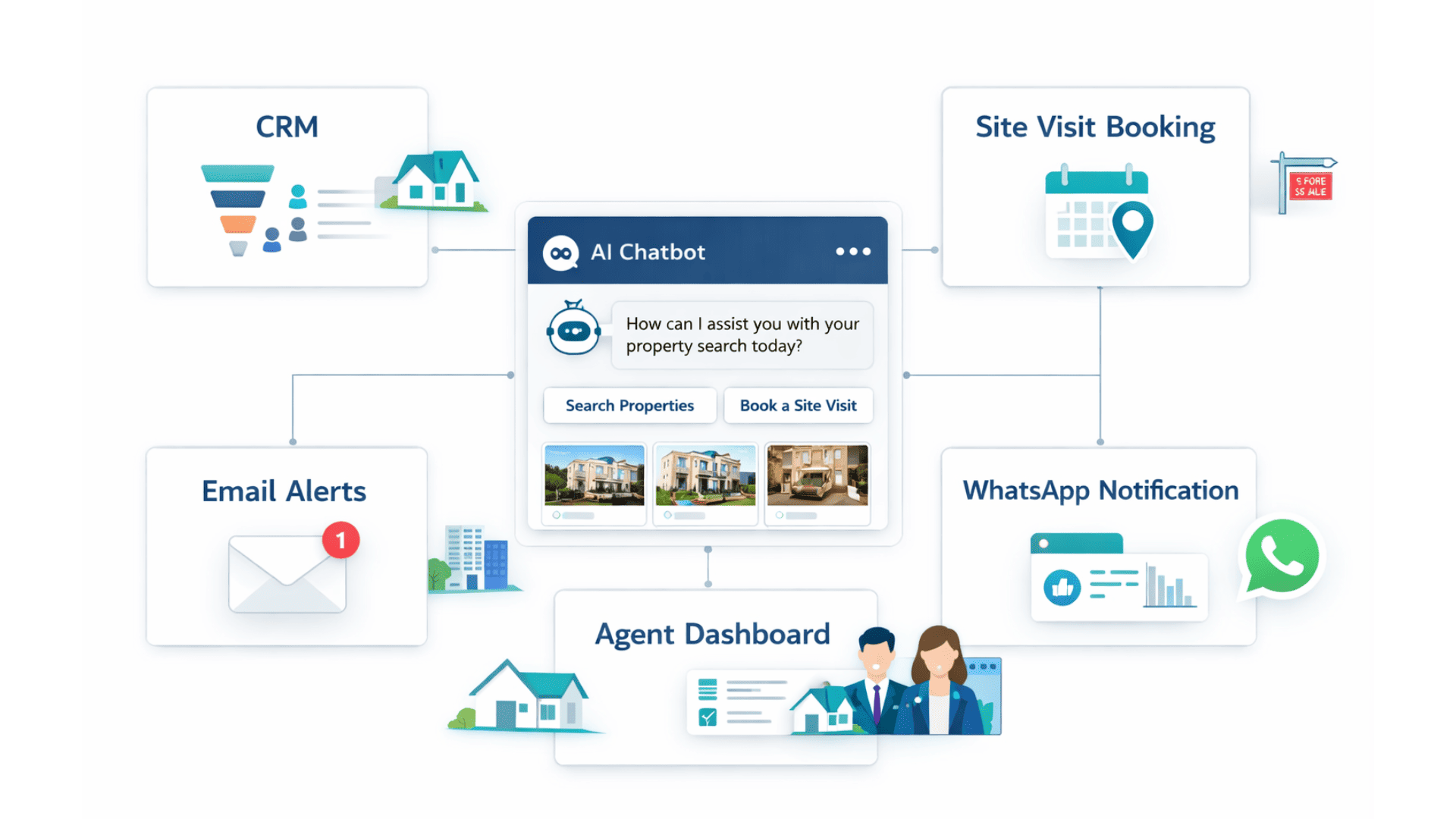
This is the simplest way to think about it:
Traffic creates opportunity.
Conversation captures intent.
Workflow creates revenue.
A real estate chatbot usually sits in the middle.
It turns anonymous traffic into structured interaction.
It turns structured interaction into qualified context.
And that context makes the next sales step much easier.
Common Mistakes to Avoid
Publishing generic responses
If the chatbot sounds polished but says nothing specific, trust drops quickly.
Asking for contact details too early
Visitors need clarity and value before they hand over information.
Trying to make the chatbot do everything
Too many jobs usually create a weak and confusing experience.
Not connecting to CRM
If lead context stays trapped inside the widget, your sales workflow gets weaker.
Letting the chatbot guess facts
Do not let it invent pricing, inventory status, or other critical property details.
No clear next step
A conversation without a callback, brochure, recommendation, or booking path wastes intent.
One more thing.
Collecting only a name and phone number is not qualification.
It is just contact capture.
Qualification means understanding:
- what the person wants
- how serious they are
- what stage they are in
- what action should happen next
That is the real job.
How to Measure Whether the Chatbot Is Working
Do not judge the chatbot only by how many chats it starts.
Track:
- chat start rate
- lead capture rate
- qualified lead rate
- callback request rate
- brochure request rate
- site-visit booking rate
- human handoff rate
- drop-off points
- unanswered questions
- lead-to-appointment progression
That is how you find out whether the chatbot is helping the business, not just producing activity.
Frequently Asked Questions
What is the best use case to start with for a real estate chatbot?
For most real estate websites, buyer qualification or site-visit booking is the best place to start because both sit close to conversion and are easier to measure.
Should a real estate chatbot be on every page?
Not necessarily. It should be placed where visitor intent is strongest, such as listing pages, project pages, seller pages, contact pages, and high-intent blog posts.
Can a chatbot qualify both buyers and sellers?
Yes. The key is to create separate conversation paths. Buyers, sellers, renters, and investors usually need different questions, routing logic, and next steps.
What should a chatbot ask before collecting contact details?
It should first create value by helping with budget, location, property type, or intent. Then it can ask for contact details once the visitor sees a reason to continue.
Can an AI chatbot replace a real estate salesperson?
No. It should handle early-stage questions, structure, and routing. Human agents are still essential for trust, negotiation, objection handling, and closing.
What is the biggest mistake in real estate chatbot setup?
The biggest mistake is launching a chatbot that sounds smart but has weak data, weak qualification, and no clear next-step workflow.
How do you stop a chatbot from giving outdated answers?
Use controlled knowledge inputs, review core property and project data regularly, and avoid letting the chatbot guess critical facts like pricing, inventory, or availability.
Does a chatbot help with real estate lead generation?
Yes, when it is connected to the rest of the funnel. A chatbot helps reduce friction, structure conversations, qualify intent, and route visitors toward meaningful actions.
Build the chatbot like a funnel asset, not a website add-on
The strongest real estate chatbots are not built around novelty.
They are built around conversion.
They answer real questions.
They qualify real intent.
They support real next steps.
If you want this to work, focus on three things:
- Choose one high-value use case first
- Connect the chatbot to accurate data and clear next-step actions
- Improve the flow based on real conversations, not assumptions
That is how a chatbot stops being interesting and starts becoming useful.
And in real estate, useful usually wins.